


Hot Air Dryer:
Why would you use a Hot Air Dryer?
Some say they have limited application as they are only effective for drying surface moisture from non-hydroscopic materials such as Polypropylene or Polystyrene.
As they are not that effective when drying hydroscopic materials such as Nylon or ABS, as the ambient air is only heated up and still contains relative levels of moisture.
However Hot Air Dryer are ideal for pre-conditioning the material so that it enters the process machinery at a constant temperature. Thereby, removing the variable of ambient conditions, resulting in;
- Improvement in surface finish
• Eliminates/reduces silver streaks
• Reduces the requirement of excessive holding and injection pressure
• Delivers a consistent charging time and pressure
When selecting your Hot Air Dryer, consider the following;
Is it insulated sufficiently so as to reduce heat loss and reduce energy consumption?
Is the contact surface Stainless steel for easy cleaning and reduce cross contamination when changing materials?
Is it easy to clean with an access door fitted?

Twin Bed Desiccant Dryers:
Hot Air Dryer are perfectly suitable for non-Hydroscopic material such as Polypropylene. However, other materials are Hydroscopic, such as Nylon 6 which can absorb up to 9.5% of its weight in moisture.
Even a small percent of moisture content is too much, and can be detrimental to the end result. Typically, causing polymer breakdown from hydrolysis or oxidation, resulting in discoloration by way of splay marks or small bubbles, and reduce physical properties of the finished article. Conversely, reducing moisture in plastic will also significantly improve the overall quality.
With over 77 years’ experience in Drying, Labotek understand this all too well, in the design of their reliable twin desiccant bed systems to deliver de-humidified air with extreme accurate temperature control and a dew point of <-40ºC or better, with a final moisture content of less than 0.02% can be achieved. (HT model 0.002%). All Labotek Desiccant drier are covered by a 3-year warranty.
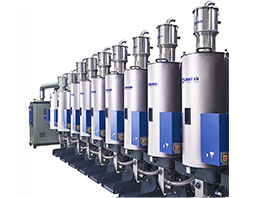
Delivering dry air to the material is only half the story. The polymer granules must be stored and prepared in Drying Hopper(s). When selecting the most suitable Drying hopper(s), the following need to be taken into account;
- Insulated sufficiently so as to reduce heat loss and reduce energy consumption
- Material contact surface should be Stainless Steel, to ease cleaning and reduce cross contamination.
- Have cleaning door on larger volume driers – for safe and easy cleaning
- The drying temperature should be independently controlled for each hopper, with protection control to ensure the material is not over dried.
- Have the ability for energy reduction with automatic air flow valve control, to balance the air flow from Desiccant Dryer to match material throughput.

Mobile Dryers – 1:
Not all applications and process plant layouts allow for a central drying system, so the processor can opt for a mobile desiccant drier instead. The rotary bed Honeycomb Desiccant drying system is becoming more popular, as they can provide a compact drying unit, when compared to a Twin bed design. They can also deliver a constant due point < -35oC or better.
In addition to the common considerations of the thickness of insulation and contact material type, the following are equally important;
- Ease of cleaning, with the aid of a removable air distributor & large access lid
- Easy to manoeuvre with large wheel and castors.
- Be able to connect a hopper loader for re-filling, with only a single power supply.
- Air or water connection not required in standard configuration, for simple installation.
- The drying and return air temperature should be monitored and control to ensure the material is not over dried and energy consumption is reduced.
- Compact footprint to locate close to process machinery.

Mobile Dryers – 2:
When Drying and conveying hydroscopic material, consideration has to be given to the amount of time the material is stored in the process machine’s hopper. If the capacity is so large the material will absorb moisture over time, prior to processing.
The fitting of a correctly sized insulated hopper will reduce the risk of any additional moisture absorption. This is especially effective for high throughput applications.
However, in cases of short runs or highly moisture sensitive materials, conveying material the to the process machine in dry air.
The solution is an integrated mobile twin desiccant bed dryer and conveying system that automatically fills the drying hopper, and blows the dried material to small volume receiver mounted directly on to the process machines infeed throat. This constant supply of material in dried air will maintain a constant and optimal process.
Labotek A/S has been producing the DDM drier series with a capacity of 60 ~ 225 litres, for a number of years, some of which are still in service after 20+ years.
Machine Mounted Dryers- 1:
Typically, most material driers cater for throughput of > 5kg / hr, to match the size of the products being produced. However, due to enhancements in product & tool design and the increase level of process control provided by modern machinery. We see an increase in the production of “mini” or even “Micro” products, which require lower material throughputs.
Which would prove to be too large for They can also deliver a constant due point < -35oC or better.
In addition to the common considerations of the thickness of insulation and contact material type, the following are equally important;
- Ease of cleaning, with the aid of a removable air distributor & large access lid
- Easy to manoeuvre with large wheel and castors.
- Be able to connect a hopper loader for re-filling, with only a single power supply.
- Air or water connection not required in standard configuration, for simple installation.
- The drying and return air temperature should be monitored and control to ensure the material is not over dried and energy consumption is reduced.
- Compact footprint to locate close to process machinery.
Labotek LESS:
Protecting polymer materials whilst in the drying process, is a matter of controlling the temperature over a given time, so as not to “over cook” it.
With their 77 years of experience, Labotek A/S fully understands how polymers behave during the drying process and how to protect them. By developing their well proven Labotek Energy Saving System (LESS). To monitor the return air temperature as passes through the material being dried.
As soon as this temperature gets close to the “Set” drying temperature, it initiates the LESS System to lower air temperature to a safe level. To protect the material from oxidising or expelling any of the volatile additives.
As new (damp) material is introduced into the dryer, the change in return air temperature noted and the original “Set” drying temperature is reinstated.